1

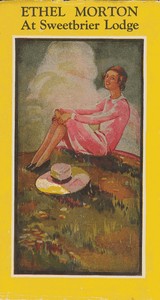
Ethel Morton at Sweetbrier Lodge — Story, Setting & Ideas
1911
2
Project Gutenberg
2011
Farm life -- Juvenile fiction; Families -- Juvenile fiction; Furniture making -- Juvenile fiction; Gardening -- Juvenile fiction; Concrete -- Juvenile fiction
Readers of public-domain and historical texts
Project Gutenberg digital edition
en
Edition facts
Words: 59,351
Reading time: 259 min
Text sections: 9
Source:
Project Gutenberg record #35364
This editorial note examines how Mabell S. C. Smith uses precise diction, dialogue, and descriptive details to depict farm life, family dynamics, and hands-on learning in 'Ethel Morton at Sweetbrier Lodge', focusing on the author's choices in the opening chapters and Philadelphia excursion.
Editorial Edition Score
4.7/5
★★★★★
★★★★★
Calculated from edition completeness, EPUB availability, text structure and catalogue metadata. Not a user rating.
Edition quality
From the first chapter, Smith establishes a world where work and wonder coexist. The opening scene—transferring newly hatched chicks from incubator to brooder—is rendered with exacting specificity: the count reaches 137, one chick has a twisted leg, and the children note the chicks' beaks tapping the wooden floor. Smith's dialogue captures distinct voices: Dicky's lisp (“He lookth pretty well”) and Ethel Blue's attentive observation (“Hear their little beaks tapping”). The author avoids sentimentalizing; instead, she grounds the moment in practical details like oatmeal flakes and cloth strips serving as surrogate wings. This blend of precise action and natural speech recurs throughout the excerpts, signaling a narrative that values competence and curiosity over melodrama.
Diction of Domestic Industry
Smith's vocabulary consistently reflects a world of making and mending. Words like “incubator,” “brooder,” “oatmeal flakes,” and “feed panth” (in Dicky's lisp) are not decorative but functional, anchoring the story in tangible processes. The author treats concrete-making, furniture building, and gardening with the same seriousness as historical sightseeing. In Chapter I, the chicks “take naturally to oatmeal flakes” and “scratch as vigorously as if he had been taking lessons.” The narration avoids abstract praise; instead, it reports behavior. This lexical choice aligns with the catalog subjects—farm life, furniture making, concrete—and suggests that Smith values doing as a mode of learning. Even the setting at Sweetbrier Lodge is introduced through its practical features: the natural condition of the land is deemed “far more beautiful than any results that Art could have brought about.” The author's diction thus builds a consistent ethos of purposeful activity.
Dialogue as Character Marker
Smith differentiates her young characters through speech patterns and content. Ethel Blue is observant and reflective, noting the chicks' humming contentment. Ethel Brown is managerial, counting and announcing totals. Dorothy is slightly clumsy but cheerful (“I have dropped one… it didn't hurt it a bit”). Dicky, the youngest, speaks with a lisp and displays precocious knowledge from older family members. In later excerpts, Helen's self-deprecating humor (“I talked altogether too much yesterday”) contrasts with Tom's admiration and Roger's methodical note-taking. Mrs. Morton speaks with authoritative ease, listing sights and directing the chauffeur. The dialogue never becomes expository; it reveals personality through reaction and initiative. For instance, when Ethel Blue mentions drawing doorways for Miss Graham, it hints at her artistic bent without explicit statement. Smith trusts readers to infer character from what the children say and how they say it.
Descriptive Economy in Setting
Smith's descriptive passages are lean but evocative. At Valley Forge, she notes the “rolling country,” “pleasant suburban towns,” and “comfortable-looking farm houses.” The historical weight is conveyed through the characters' emotional response: they “felt like real pilgrims at a shrine,” remembering “the bitter suffering of the American soldiers.” The description of Christ Church highlights “high box pews” and the imagined “elaborately arranged head-dresses of the ladies and powdered wigs of the gentlemen.” Smith selects a few telling details rather than cataloging every feature. The Schuylkill River is described as “sweeping between peaceful banks, far different from those that hem it in farther down.” This contrast between pastoral and industrial landscapes is typical of Smith's method: she uses setting to reinforce the story's values of natural beauty and historical awareness. The descriptions serve the narrative without overwhelming it.
Structure of Learning Through Experience
The excerpts reveal a consistent pattern: characters encounter a problem or opportunity, discuss it, and then act. In Chapter I, the challenge is transferring chicks; the solution involves counting, feeding, and observing. In Chapter X, the family plans a day in Philadelphia: Mrs. Morton suggests sights, Roger writes them down, and they secure the same chauffeur. The narrative moves from planning to execution, with dialogue interspersed. Smith often includes a moment of reflection—the children imagining historical figures in Christ Church, or Ethel Blue deciding to sketch doorways. This structure mirrors educational philosophy of the era: learning by doing, with adult guidance. The author does not lecture; she shows the process. Even the chapter titles (“A New Craft,” “Playing with Concrete,” “The Law of Laughter”) promise activity. The result is a story that feels instructional without being didactic, because the instruction is embedded in character-driven action.
Readers approaching Ethel Morton at Sweetbrier Lodge will find a narrative that rewards attention to craft. Smith's choices in diction, dialogue, and description consistently reinforce a world where knowledge is practical, curiosity is active, and family cooperation is the norm. The author's restraint—her refusal to overexplain or sentimentalize—gives the story a quiet authenticity. For those interested in early twentieth-century children's literature, this book offers a clear example of how domestic and educational themes were woven into fiction without sacrificing narrative momentum.
Reader reflection
How will you remember this book?
Save your reaction, strongest insight, and memorable passage.
Your progress
0
/
10
2
Did this book hold your interest?
3
Would you recommend this book to another reader?
4
How much effort did this book require?
5
What was its emotional impact?
6
How strong was your personal connection to the text?
7
Could you see yourself revisiting this book?
8
How useful were the ideas in this book?
9
What did this book teach you most?
10