1

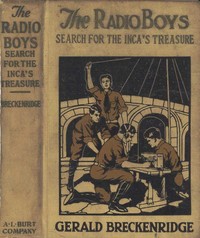
The Radio Boys' Search for the Inca's Treasure — Inside the Classic
422
0
Project Gutenberg
2011
Boys -- Juvenile fiction; Treasure troves -- Juvenile fiction; Radio -- Juvenile fiction; South America -- Juvenile fiction
Readers of public-domain and historical texts
Project Gutenberg digital edition
en
Edition facts
Words: 54,295
Reading time: 237 min
Text sections: 7
Source:
Project Gutenberg record #35987
Gerald Breckenridge's 1922 adventure follows three radio-enthusiast boys to South America, where Inca legends and a hidden city intersect with early wireless technology. The catalog subjects (treasure, radio, South America) are present, but the excerpts show the story focuses more on cultural encounter and political intrigue than on radio operation.
Editorial Edition Score
4.7/5
★★★★★
★★★★★
Calculated from edition completeness, EPUB availability, text structure and catalogue metadata. Not a user rating.
Edition quality
The Radio Boys' Search for the Inca's Treasure, published in 1922, opens not with a radio signal but with a steamer arriving at Valparaiso. The three chums—Jack Hampton, Frank Merrick, and Bob Temple—are immediately drawn into tales of Inca treasure told by a fellow passenger. Radio, despite being the series' namesake, appears in the table of contents as a tool for communication with a hidden Inca city, not as the central plot driver. The catalog subjects list 'Radio -- Juvenile fiction' and 'Treasure troves -- Juvenile fiction,' but the excerpts reveal a story more concerned with cultural encounter and political maneuvering than with technical radio operation.
Radio as a Plot Device, Not a Technical Manual
The catalog subject 'Radio -- Juvenile fiction' suggests a focus on wireless technology, but the excerpts show radio is used sparingly. In the table of contents, chapters like 'Radio Invades the Monastery' and 'Radio a Link to the Past' indicate radio serves as a plot device to bridge the boys' modern world with the Inca civilization. However, the actual text excerpts do not describe radio operation in detail. Instead, the boys rely on storytelling and diplomacy. For instance, when Mr. Hampton and Don Ernesto meet the Inca Council, Prince Huaca cautions them not to speak of radio, hinting at its strategic value. The radio outfit is mentioned only in the frontispiece caption, comparing it to an army field outfit. Readers expecting technical descriptions will find radio used more as a symbol of modernity than as a hands-on tool.
Treasure as a MacGuffin for Cultural Encounter
The catalog subject 'Treasure troves -- Juvenile fiction' implies a hunt for gold, but the excerpts shift focus to the Inca society itself. The treasure is referenced early as 'Inca treasure' by a commercial traveler, but the bulk of the excerpts depict the boys imprisoned in an Inca acropolis, interacting with Prince Huaca and the Council. The treasure hunt becomes secondary to navigating the political factions within the Inca city. Jack worries about his father's safety, Frank jokes about being 'Young Wizards,' and the group discusses 'two parties at court' with conflicting views on isolation versus expansion. The treasure is a catalyst for the journey, but the narrative dwells on the encounter with a living Inca culture, not on the acquisition of gold.
South America as a Setting for Adventure and Politics
The catalog subject 'South America -- Juvenile fiction' is accurate but understated. The excerpts portray South America as a land of 'vast mountains, vast rivers, vast jungles' and 'unconquered tribes,' as Jack describes. However, the setting quickly narrows to the Inca city, where the boys face a complex political situation. The Council debates expansion and population control, with references to a 'Convent of the Vestal Virgins.' The boys are not merely explorers but prisoners navigating a foreign court. The setting is not a generic jungle but a specific, hierarchical society with its own conflicts. The excerpts show the boys using diplomacy and humor—Frank's 'jollying'—to maintain morale, rather than relying on technology or brute force.
Readers should approach this book as a period adventure that uses radio as a narrative convenience rather than a technical focus. The catalog subjects hint at treasure and technology, but the excerpts reveal a story more interested in cultural contact and political intrigue. The Radio Boys' series formula—plucky teens with a specialty—here serves as a vehicle for a South American fantasy. For a fuller understanding, compare how radio is deployed in other entries in the series, such as The Radio Boys on the Mexican Border.
Reader reflection
Take a moment to reflect on this book
Create a short personal record of your experience with this book.
Your progress
0
/
10
2
How did the book work for you overall?
3
Would you recommend this book to another reader?
4
How easy was the book to follow?
5
How original did the book feel?
6
Did any part of the book feel personally relevant?
7
Could you see yourself revisiting this book?
8
Which aspect of the book did you value most?
9
What changed or sharpened your thinking?
10