1

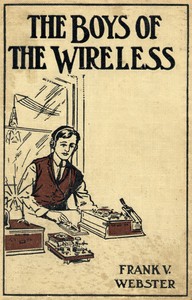
The Boys of the Wireless; Or, A Stirring Rescue from the Deep — Text and Context
1931
1
Project Gutenberg
2011
Kidnapping -- Juvenile fiction; Rescues -- Juvenile fiction; Mystery and detective stories; Telegraph, Wireless -- Juvenile fiction
Readers of public-domain and historical texts
Project Gutenberg digital edition
en
Edition facts
Words: 43,055
Reading time: 188 min
Text sections: 28
Source:
Project Gutenberg record #35044
Tom Barnes builds a wireless station in a blasted oak, only to have it commandeered by intruders who send a coded message to a steamer. The story contrasts mechanical ingenuity with criminal intrusion, as Tom's hobby becomes entangled in a kidnapping plot.
Editorial Edition Score
4.8/5
★★★★★
★★★★★
Calculated from edition completeness, EPUB availability, text structure and catalogue metadata. Not a user rating.
Edition quality
The story opens with Tom Barnes explaining his wireless apparatus to his friend Ben Dixon, who jokingly calls the antennae an "umbrella." The boys' easy banter—Ben's admiration for Tom's "genius" and Tom's matter-of-fact replies—establishes a tone of youthful competence. But the wireless, built in a blasted oak, is not merely a toy; it becomes a tool for both rescue and coercion. When two men break into the tower and lock Tom in a closet, they use his own equipment to flash a coded message to the steamer Councillor. Tom, trapped, tries to memorize the transmission, revealing his quick thinking under pressure. The arrival of Bill Barber, a former antagonist, adds an unexpected twist: he frees Tom, but his motives remain unclear.
The Wireless as a Double-Edged Tool
The wireless in this story is not just a marvel of boyish invention; it is a contested space. Tom builds it with "wires and rods" running up the tree, and he uses a relay to catch signals. Yet the same apparatus that allows him to communicate is turned against him. The intruders, who claim to be "some wireless" themselves, force Tom to witness their misuse of his station. They send a message in "private code-words" that Tom cannot decipher, emphasizing that the technology is neutral—its value depends on the user. The tower, meant for connection, becomes a prison when Tom is locked in a closet with a "small circular slit" for air. This duality—the wireless as a means of rescue and a tool for crime—runs through the excerpts, though the full extent of its role is not shown here.
Contrasting Characters: Tom, Ben, and Bill Barber
The excerpts present three distinct boy characters. Tom is resourceful and calm: even when trapped, he "contented himself by trying to recall" the message and figure out the men's motives. Ben is the admiring sidekick, quick with a joke but mechanically inclined himself. Bill Barber, introduced as the head of the "Black Caps," initially seems threatening, but when he frees Tom, his behavior is "nothing belligerent or threatening"—instead, he is "anxious to please." This reversal is striking: Bill appears "more tidy than usual," suggesting a change in circumstances. The text hints at a past rivalry (the Black Caps are likely a gang), but Bill's sudden helpfulness raises questions. The contrast between Tom's uprightness and Bill's ambiguous loyalty creates a tension that the excerpts do not resolve.
The Mystery of the Coded Message
The central plot device in the excerpts is the wireless message sent to the steamer Councillor. The intruders use a "cypher key" and a two-sheet message, targeting a passenger named Daniel Ritchie. Tom, locked in the closet, strains to overhear the transmission, but the code-words are "utterly unintelligible" to him. This secrecy drives the plot: the reader knows as little as Tom does. The men's casual cruelty—locking Tom in and leaving him—contrasts with the precision of their coded communication. Later, Bill Barber's appearance and his puzzling friendliness suggest that the mystery may involve more than a simple crime. The excerpts do not reveal the message's content or its connection to the kidnapping mentioned in the chapter title, leaving the reader to infer that the wireless is central to a larger scheme.
Readers should pay close attention to how the wireless technology is described—not as magic, but as a set of practical components (antennae, relay, key) that the boys understand intimately. The story's tension arises from the collision of this technical competence with adult criminality. The excerpts offer only fragments of the plot; the full narrative likely hinges on whether Tom can decode the message and whether Bill Barber's allegiance has truly shifted.
Reader reflection
How did this book work for you?
Your answers remain private and are stored only in this browser.
Your progress
0
/
10
2
Was reading this book enjoyable?
3
Would you pass this book on to a friend?
4
What was the reading difficulty like?
5
How original did the book feel?
6
How understandable was the text?
7
Did any part of the book feel personally relevant?
8
What did you appreciate most?
9
In one sentence, what did you learn?
10